Flowering and fruiting phenology of Castanopsis tribuloides
In 2024, I visited Mizoram University to give a lecture at a summer school on chronobiology in India. Before the morning sessions, students guided us on nature walks around the university campus. It was a fascinating opportunity for me to experience the unique subtropical ecosystem of Mizoram. I was particularly interested in the reproductive timing of organisms in this highly seasonal environment. During one of these walks, I noticed Castanopsis trees in flower, with numerous butterflies visiting the flowers. This immediately raised a question: when would these flowers develop into mature fruits?
Castanopsisand other Fagaceae species are known for delayed fertilization, in which fertilization can occur many months after pollination. Because there are very few records of flowering and fruiting phenology of Castanopsis in India, I thought that systematically tracking flowering and fruit maturation in these trees would provide valuable information about reproductive strategies in subtropical trees.
With the generous help of a Ph.D. student, Lalsiamkima Hnamler, who has extensive knowledge of the local plants and other organisms, we began monthly monitoring of Castanopsis tribuloides. Each month, Lalsiamkima photographed three individual trees, and we recorded the presence and developmental stages of male flowers, female flowers, and fruits. This systematic approach allowed us to track the complete reproductive cycle over an extended period.
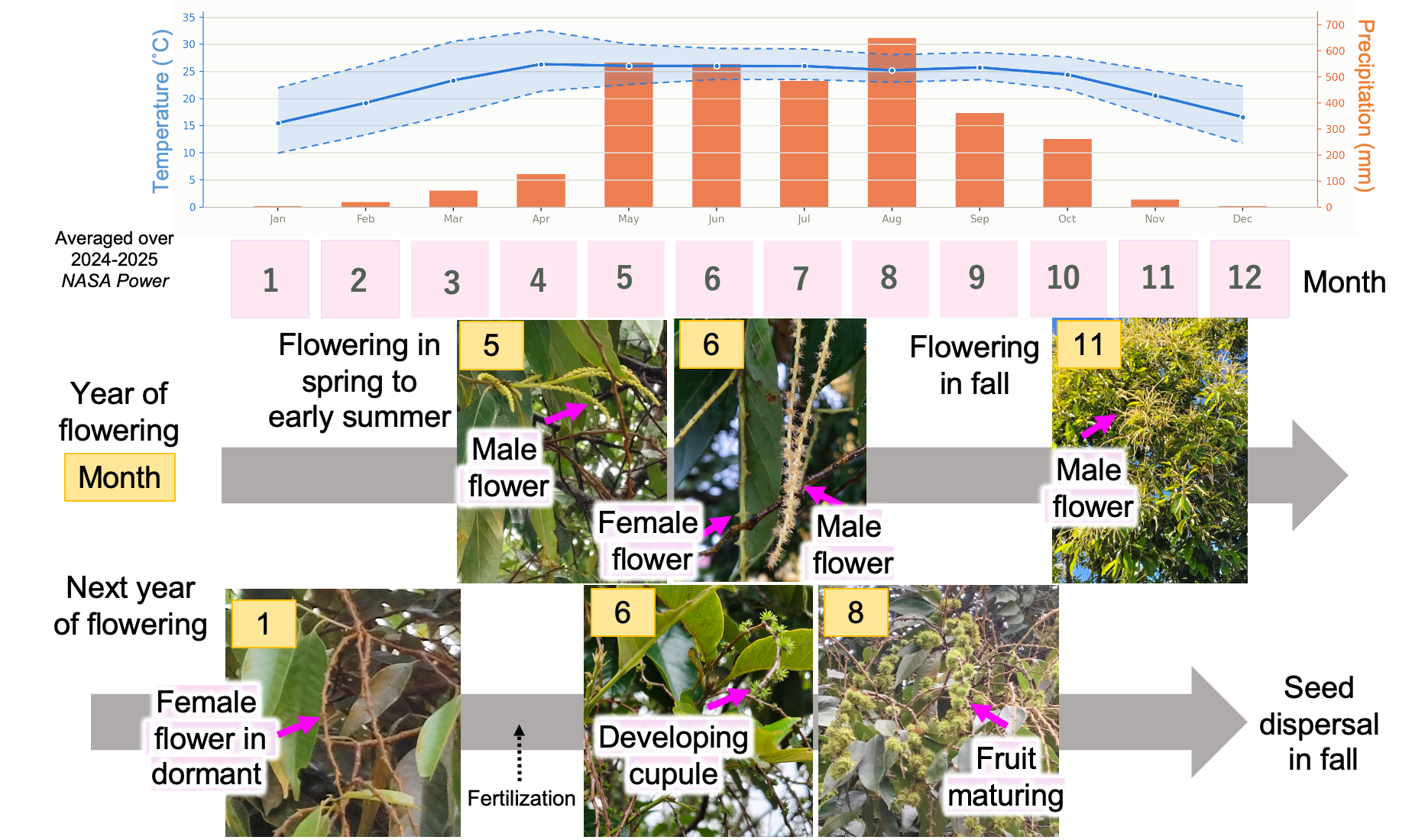
図:Flowering and fruiting timing of Castanopsis tribuloides
Our observations revealed an intriguing reproductive cycle. Castanopsis tribuloides flowered twice a year, once from spring to early summer and again in autumn. This biennial flowering pattern is particularly interesting as it demonstrates adaptation to the seasonal climate of the subtropical region.
Female flowers from both flowering periods entered a dormant state during winter. Development resumed in spring, with cupules beginning to develop around May, and the fruits matured in autumn. Thus, fruit development required approximately one to one and a half years from flowering to maturation, depending on the flowering season.
Although we could not directly determine the timing of fertilization, our observations suggest that fertilization likely occurs in spring, approximately one year after spring flowering but only about six months after autumn flowering. This pattern of delayed fertilization is consistent with what is known about Fagaceae species, but the specific timing in this subtropical population was previously undocumented.
Winter temperatures in Mizoram are relatively mild, with minimum temperatures of approximately 10°C. Nevertheless, our observations suggest that these temperatures may be sufficiently low to induce or maintain winter dormancy of female flowers. This raises an interesting question about how seasonal temperature cues regulate delayed fertilization and reproductive phenology in subtropical Castanopsis.
This study contributes to our understanding of flowering phenology and reproductive strategies in tropical and subtropical plants. The extended timeline from flowering to fruit maturation in Castanopsis, coupled with the biennial flowering pattern and winter dormancy, suggests sophisticated mechanisms for optimizing reproductive success under variable seasonal conditions. Further research using mathematical modeling and molecular approaches could help elucidate the mechanisms underlying these fascinating reproductive adaptations.
Acknowledgments
I am very grateful to Lalsiamkima Hnamler for his dedicated efforts in conducting the monthly monitoring and to Takenori Shagawa for species identification. This research was conducted during a collaborative visit to Mizoram University and was supported by the chronobiology summer school program.
September 22, 2026