Summer Research Visit at Kyushu University
I’m jolted awake at 06:37 as Ito Guest House’s wooden structure spasms violently. I roll under the nearby desk, where I crouch, groggy with sleep, until I’m sure the earthquake has passed, unused to such a Monday morning alarm.
*
It’s my final week at the Mathematical Biology Laboratory here at Kyushu University, whose Ito Campus is a sprawl of rectangular buildings perched atop a forested mountain on the Itoshima peninsula, twenty kilometres from Fukuoka’s city centre. I now sit on the ninth floor in an air-conditioned office, steady enough to tackle my remaining to-do items before I fly home next week. The top one reads “blog post.”
My summer visit began in mid-June with two weeks of torrential rain, whose rare pauses gave me brief windows to explore the coastline and the forests nearby first on foot, and eventually by bicycle. Once the rainy season ended, however, I soon missed the coolness of downpour: July’s baking sunshine and heavy humidity confined many locals to the climate-controlled indoors, but I forced myself outside every chance I could, losing water to sweat almost as quickly as I could drink it. Now, as my stay in Japan draws to a close, August’s looming cloud cover warns of the typhoons to come.
This morning’s earthquake was my second of the summer: the first shook this very ninth-floor office for nearly twenty seconds one afternoon late last month. While nearby cell phones blared warning alarms, my Japanese colleagues were calm, so I didn’t think to panic. I simply stood, frozen, trying to wrap my mind around the force required to give a building of this size a seizure. Eventually, the shaking stopped. Soon afterwards, a professor from our lab hurried in to check on us: “Is everyone OK?”
My Japanese colleagues and friends all demonstrate this innate kindness. Everyone I encounter wants my experience here to be positive, for me to have a good impression of the people, the culture, the country itself. This presents itself as suggestions for local festivals to attend (“Hakata Gion Yamakasa is very special, although you have to wake up early!”) and other cities to explore (“Nagasaki is beautiful, and since you are interested in old trees, you can see Hibakujumoku there”), but also advice on how to engage with students and colleagues: “Many Japanese are shy, especially in English, but if you are patient and speak with them, they will open up.”
My fumbling attempts at Japanese helped, I think. Bumbling through “Doozo yoroshiko onegaishimasu” and clumsily bowing seemed to endear people to me, though nothing was as effective as “Sumimasen! Nihongo hetadesu,” which without fail triggered laughter and polite protestations of the opposite. “You’re humble, just like a Japanese person,” a friend remarked, nodding with approval.
A custom in the lab helped greatly with my integration: when visitors arrive, not only do they give a typical talk in the departmental seminar, but they meet with each lab member one-on-one to hear about their work. My first two weeks were thus enriched with daily hour-long discussions about the wide variety of research taking place here, from reproductive synchrony in trees to the historical evolution of the shape of vases in Japan, and everything in between: metabolic systems, chemical reaction networks, plant genetic architectures, biogenic volatile organic compounds, cancer-epidemiology intersections, and more, tied together with mathematical modelling, data analysis and other quantitative approaches. As someone whose research has mostly centred on cancer, I was excited at the opportunity to learn about different organisms and systems.
When I first arrived, I was asked what my summer goals were. I didn’t hesitate: “If there’s any way I can spend time outside...” And so, I was thrilled to join some sample-collection fieldwork excursions, both on campus as well as up a mountain in a neighbouring prefecture. I’m not sure my stream of questions (“Did I cut the leaves to the right size?”, “Why did we pick that tree?”, “Are there enough buds on this branch?”, “What’s in the vial?”, “You know what this butterfly net reminds me of?”, and so on) was standard for the activity, but I hope my companions were entertained rather than belaboured by my presence. Besides my enthusiasm for doing work under the sun rather than at my computer screen’s glow, I felt invigorated by the team effort that fieldwork required: undergraduates all the way up to the head of the lab participated in the manual activity, which, aided by going for lunch afterwards, strengthened the group’s bonds.
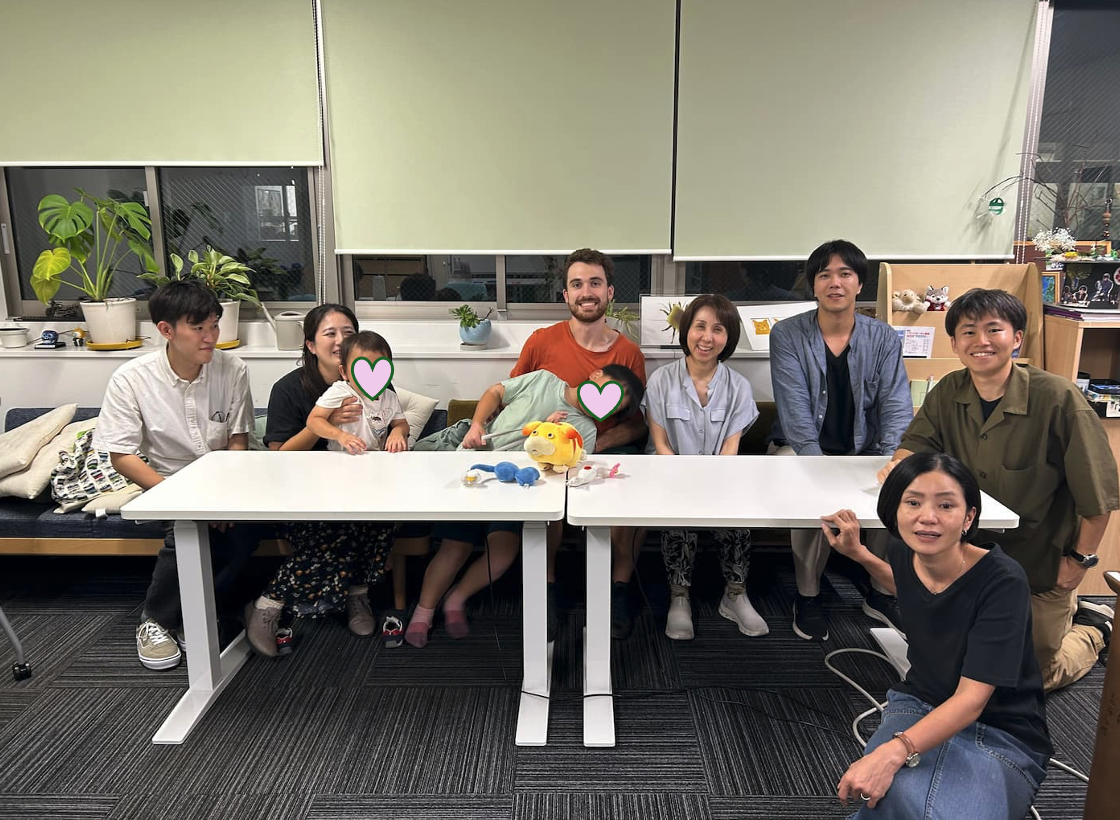
At the Mathematical Biology Laboratory, undergraduate and graduate students often work together in the kitchen, which serves as a central meeting space. Supervisory meetings, group seminars, lunches, card games, tea breaks and impromptu chats all take place on the sofas and chairs surrounding tables upon which lie snacks brought from lab members returning from travels (another custom worth adopting!). One of my first weeks here, this common room was repotted via a synchronised collective effort (exemplifying, to me, certain aspects of Japanese culture), its belongings transplanted in a matter of hours two doors down the hallway, to be replaced exactly as they were before. I had ignored their attempts to dissuade me from helping (“You're a visitor, you shouldn’t have to move our stuff!”), and, when the job was done, I felt like a true member of the lab.
A final tradition that I hope to bring home with me begins with this blog post. When lab members attend an international conference, they give a brief presentation during the group meeting about their experience, exposing the others to elements of research culture abroad. I believe that only by encouraging communication across borders can international, interdisciplinary research be excellent, and it is for this reason that I am very grateful to the Japan Society for the Promotion of Science for providing me the opportunity to visit, to observe, to discuss, to exchange, and, ultimately, to learn here at Kyushu University.
Christo Morison, 17 August 2026